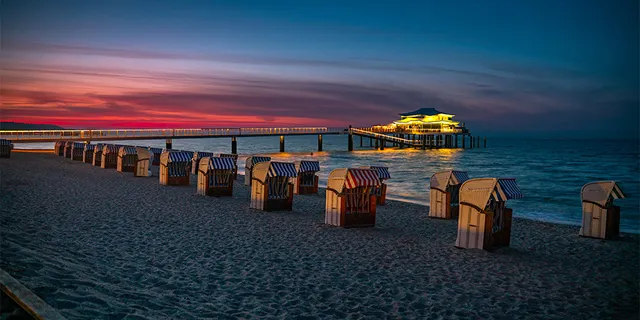
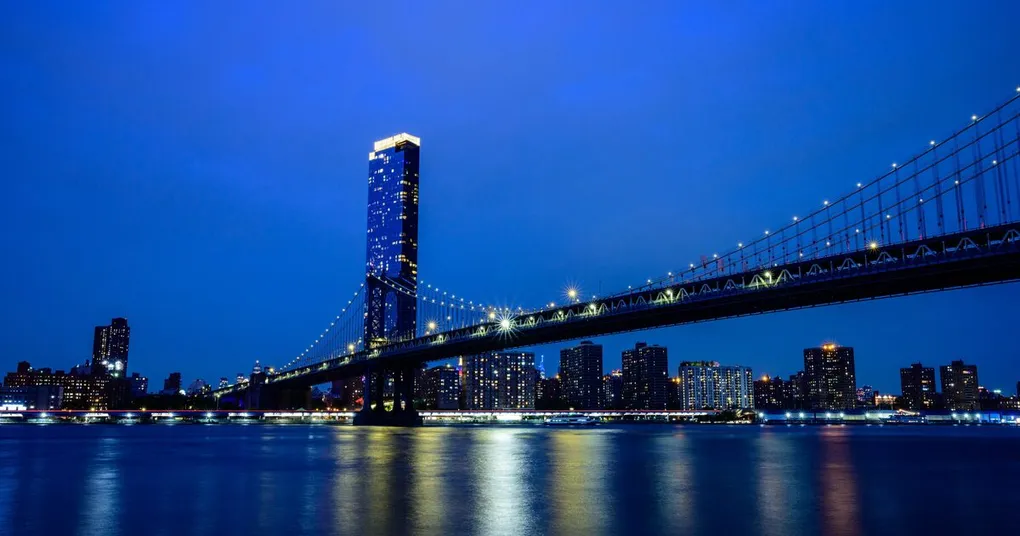
Blue hour is the twenty-odd minutes after sunset when the sky turns deep cobalt and the streetlights are already burning. Both of them meter within a stop or two of each other, which is the whole trick: it is the only time of day when a skyline and the sky behind it can be correctly exposed in the same frame.
Golden hour gets the attention. Blue hour is the one that makes cities, bridges, and buildings look the way they do on postcards, and it starts about ten minutes after most photographers pack up.
What Is Blue Hour in Photography?
Blue hour is the stretch of twilight when the sun sits roughly 4 to 8 degrees below the horizon and the sky reads as saturated blue rather than orange or black. It happens twice a day, once before sunrise and once after sunset. Unlike civil twilight (0 to 6 degrees below) or nautical twilight (6 to 12 degrees below), blue hour has no official astronomical definition; the 4 to 8 degree range is simply where the blue is strongest, straddling the end of civil twilight and the start of nautical twilight.
The color has a different cause than the blue of a midday sky. Daytime blue comes from Rayleigh scattering. Twilight blue is dominated by ozone: molecules in the stratosphere absorb the longer orange and red wavelengths through what is known as Chappuis absorption, after the French chemist James Chappuis, who noticed in 1880 that light passing through ozone gas takes on a blue tint. With the direct red light gone, blue is what is left.
The result is a light source with no direction: it arrives from the whole sky at once, so nothing casts a shadow and no wall shows texture. It is also cool and dim, which is exactly what puts the sky on speaking terms with a lit window.
When Is Blue Hour, and How Long Does It Last?
Blue hour opens about 20 minutes after sunset at mid-latitudes and closes about 40 minutes after, giving you roughly 20 minutes of usable light with maybe 10 minutes of peak color in the middle. The morning session runs the same sequence in reverse and ends at sunrise, which means you have to be set up in the dark.
| Sun position | What the sky does | Evening timing (mid-latitudes) |
|---|---|---|
| 6° above the horizon to 0° | Golden hour: warm, low, directional | Last ~60 min before sunset |
| 0° to 4° below | Afterglow: pinks and magentas overhead | 0-20 min after sunset |
| 4° to 8° below | Blue hour: deep blue sky, lights balanced | ~20-40 min after sunset |
| Below 8° | Night: sky goes black, lights blow out | 40 min onward |
Latitude changes the math. Near the equator the sun drops almost vertically and the window can be gone in 15 minutes. Above 50 degrees latitude in summer it skims along under the horizon and blue hour stretches past an hour, or never properly ends.
Do not estimate from sunset time. PhotoPills (a one-time purchase of around $11) and The Photographer’s Ephemeris both calculate blue hour start and end times for your GPS coordinates; free apps like Sun Surveyor Lite give you civil twilight, which is close enough to plan around. Either way, arrive before sunset rather than before blue hour, because composing, leveling a tripod, and setting focus all take three times longer by phone light.
What Camera Settings Work for Blue Hour Photography?
Blue hour photography settings are not one set of numbers. They are a slow slide from handheld exposures to 30 second ones across about 20 minutes.
| Setting | Start of blue hour | End of blue hour |
|---|---|---|
| Mode | Manual or aperture priority | Manual |
| ISO | 100 | 100 on a tripod, 1600-3200 handheld |
| Aperture | f/8 | f/8, or f/1.8-f/2.8 handheld |
| Shutter | 1/15 to 1 second | 4 to 30 seconds |
| White balance | Fixed, around 4000K | The same fixed value |
| Focus | Manual, set while it is light | Manual, do not touch it |
| Drive | 2 second timer or remote | 2 second timer or remote |
| File | RAW | RAW |
Three of those rows carry the most weight.
ISO stays at base and the shutter absorbs the change. Nothing in a cityscape moves except traffic, and traffic recorded over 8 seconds becomes light trails. Raise ISO only when you have no tripod or a person in the frame.
Exposure compensation goes negative. Metering systems push any dark scene toward mid-gray, so left alone the camera overexposes blue hour and washes that cobalt sky out to pale slate. Start at -0.3 to -1 EV, or work in full manual off the histogram.
Aperture controls your streetlights. Point sources turn into rays as you stop down: f/11 to f/16 gives clean, defined starbursts. Past f/16, diffraction starts softening the whole frame.
And re-meter constantly: a composition that needed 1/2 second when the window opened can need 8 seconds by the time it closes.
Auto White Balance Will Erase the Blue
Auto white balance is the fastest way to ruin a blue hour photo. It reads the blue cast as a mistake and corrects it, so you come home with a gray-brown sky where you clearly remember cobalt. Set white balance manually and leave it for the whole session:
- Daylight (around 5500K) renders the scene close to what your eye saw.
- Around 3800-4000K deepens the blue and pulls warm artificial lights back toward neutral. This is the look most cityscapes are after.
- Tungsten (around 3200K) pushes the sky strongly blue and neutralizes heavily orange sodium streetlights, at the cost of a stylized result.
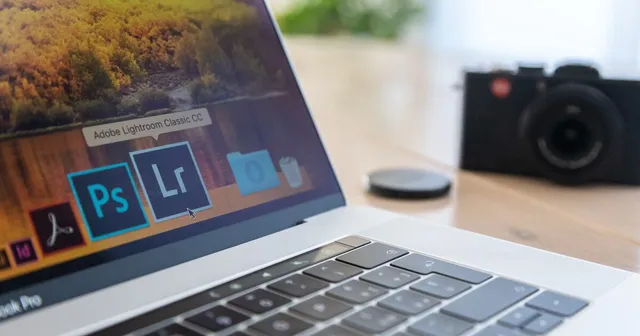
RAW lets you change this afterwards, but a fixed value keeps every frame in the sequence matched, which matters the moment you blend two exposures of one scene. Our guide to white balance in photography covers the control in general.
Blue Hour vs Golden Hour: What Each One Is For
Golden hour and blue hour are not alternatives, they are consecutive. In the evening one hands off to the other about 20 minutes after the sun disappears.
| Golden hour | Blue hour | |
|---|---|---|
| Sun position | 6° above the horizon to 0° | 4° to 8° below the horizon |
| Evening timing | Last ~60 min before sunset | ~20-40 min after sunset |
| Duration | About 60 minutes | About 20-30 minutes |
| Light | Warm, directional, long shadows | Cool, soft, no shadows at all |
| Best for | Portraits, landscapes, skin tones | Cityscapes, architecture, water, silhouettes |
| Tripod | Optional | Effectively mandatory |
| Difficulty | Forgiving | Exposure changes by the minute |
The practical move is to shoot both from one spot: warm frames while the sun goes, then wait out the fifteen dead minutes of afterglow and shoot the same composition again once the sky turns. Two very different images, one tripod position. Our guide to golden hour photography covers the first half of that session.
What to Shoot During Blue Hour
Blue hour rewards subjects that carry their own light and punishes subjects that need the sun.
Cityscapes and skylines. Wait until the lit windows and the sky sit within about two stops of each other, then shoot. Too early and the buildings look dim against a bright sky; too late and the windows glow like white holes.
Architecture and real estate exteriors. The twilight exterior is often the frame a property listing leads with, and it costs one tripod position and a handful of bracketed shots. Agents usually want it the same evening, which is a good argument for sending a gallery link through something like Picstack rather than 2 GB of email attachments.
Water, without an ND filter. Blue hour hands you 4 to 30 second exposures naturally, so rivers, harbors, and coastlines smooth out for free. That is the effect photographers buy 10-stop neutral density filters to get in daylight.
Silhouettes. With a bright sky and no directional light, anything between you and the horizon reads as a clean black shape: bridges, piers, ferris wheels, a lone tree on a ridge.
Portraits, if you bring a light. The flat sky gives a face no modeling whatsoever. Put your subject beside a shop window, a streetlight, or a small LED panel and let the blue sky be the background rather than the light source.
Where Blue Hour Shots Go Wrong
Arriving when blue hour starts. By then the best frames are already running. Scout in daylight, set up before sunset, and be waiting when the color arrives.
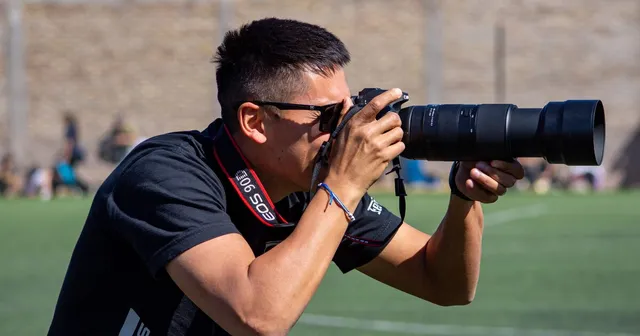
Hand-holding “just this one”. At 1/4 second nothing is sharp, however steady you think you are. A tripod plus a 2 second timer removes the two biggest sources of blur in one move.
Judging exposure off the rear screen. A bright LCD in a dark environment makes badly underexposed frames look perfect. Read the histogram instead: data pushed well to the right, lit windows short of clipping.
One exposure for a scene with lit windows. The gap between an interior light and a shaded facade regularly exceeds what a single frame can hold. Bracket three exposures two stops apart and blend them later.
Blue hour is the shortest usable light in photography and by far the easiest to schedule, because it happens tonight and it happens wherever you already are. Pick a bridge, a waterfront, or a street corner you pass every week and shoot it from the same spot several evenings running. You will learn the exact minute your own city looks its best faster than any app can tell you.